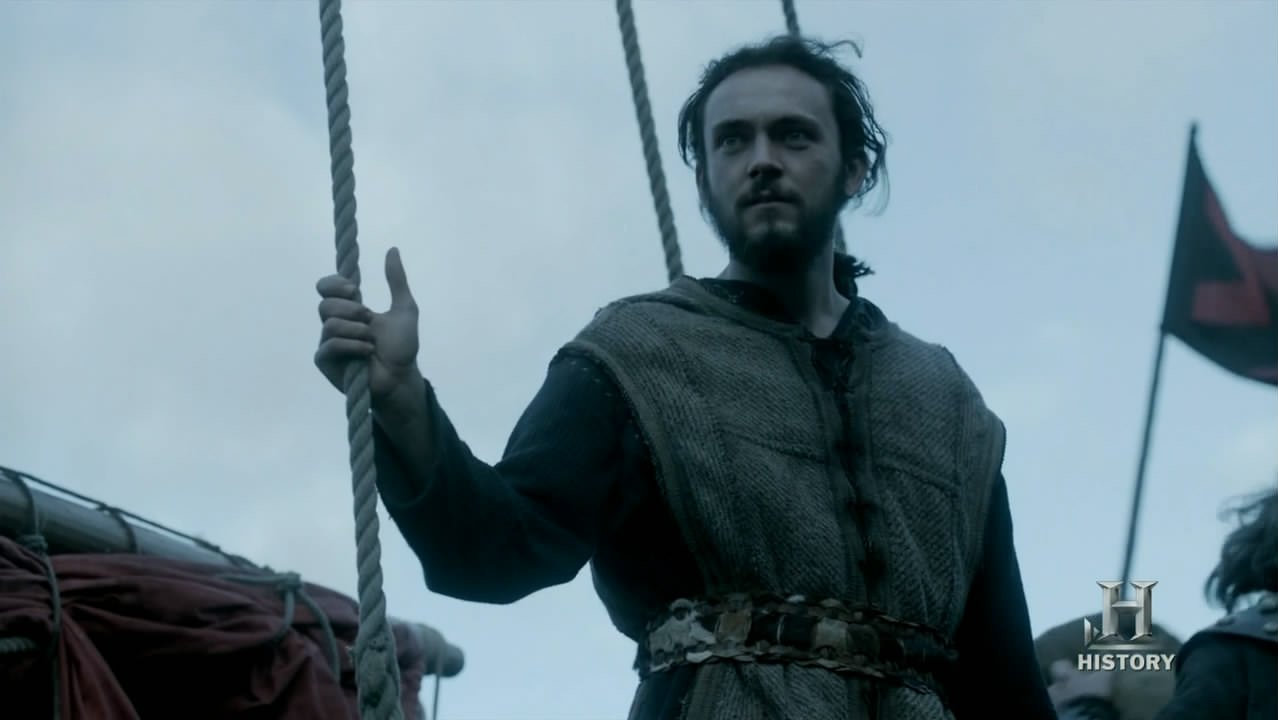
Through my friend Beth, I discovered the History channel series Vikings. History’s always been a passion of mine and after doing a little more digging into the production of the show I found my interest piqued and gave it a go. The result, I’ve come away a full blown fan of the series caught up all the way to the end of Season 4. Now if you haven’t seen it yet, the series follows the exploits of the legendary Viking king Ragnar Lothbrok. While some bits are fictionalized for the sake of the plot, the show is more or less authentic in its portrayal of the time period. But I’m not here to discuss the series as a whole but rather one of my favorite, if not my favorite part of the whole show - the character of Athelstan.
(Spoilers for Vikings)
Introduced in the second episode of Season 1 “Wrath of the Northmen”, Athelstan is a Christian monk from the monastery of Lindisfarne in Northumbria, England. The Vikings, led by Ragnar, raid the monastery and kill or take prisoners to be sold into slavery. Athelstan is one such taken by the Vikings back to their home of Kattegat after Ragnar sees that Athelstan can speak the Norse language and can be useful to him in his ambitions. Ragnar keeps Athelstan as his slave as his part of the spoils and that turns out to be a smart move on Ragnar’s part as he learns much of England from Athelstan about their language, politics, and culture. What quickly becomes apparent in Ragnar’s growing fascination and fondness towards the Christian. Ragnar, even though he has no reason to, treats Athelstan very well and more or less declares him a free man as early as the third episode. He also never tries to force Athelstan to abandon his faith and allows him to continue his Christian faith. By Season 2 a deep friendship between the two men has formed and as Ragnar rises to become King, Athelstan rises with him attaining a position of Stivardur (steward) in Ragnar’s house, or at least a position similar to that. This is all well and good but what grabbed me about Athelstan was the story his character was given, and how it spoke to me as a Christian.
In his initial introduction, it’s clear that Athelstan is devout in his faith. After his abduction from Lindisfarne, he begins to show signs of doubt in God. He wonders why God has allowed him to live among heathens (His words not mine) and expresses anger at him. One of the most telling moments in the show that captures where Athelstan’s faith in God is at that moment comes in episode 6 “Burial of the Dead”. In the previous episode, Earl Haraldsson attacked Ragnar’s house and burned it to the ground. When Ragnar’s family go through the ruins to see what they can salvage, Athelstan comes across his Bible which disintegrates in his hands, symbolizing how his faith in God has begun to crumble. This moment is the big turning point in Athelstan’s story as now he finds himself torn between his Christian faith and the Viking culture he also finds himself increasingly fascinated by.
By Season 2, not only has Athelstan become a Viking, he also seems to have renounced his faith in God. After one raid Floki, a devoted follower of the Norse gods presents Athelstan with a Bible as a taunt but Athelstan responds with, “Odin is my god.” Floki naturally doesn’t believe him. After another raid on in England, this time, the monastery of Winchester in Wessex, Athelstan discovers Bible pages that the monks were working on and out of nostalgia begins to finish it. A monk that was hiding misinterprets his actions and tries to stop him from destroying the pages and in self-defense Athelstan kills him. After seeing the result of his actions, it’s clear that Athelstan is left traumatized by this and regrets his actions. After the raid, Ragnar has to return to Kattegat to reclaim it from Jarl Borg, but Athelstan decides to remain in Wessex to assist the Vikings remaining there. The English attack not long after Ragnar has departed, kill many of the Vikings, and take Athelstan prisoner. Athelstan is then sentenced to death for apostasy but is ultimately spared and pardoned by Egbert, the King of Wessex. During his time in Wessex, Athelstan begins to experience a crisis of faith as he finds he loves both Christ and Odin. In one scene Athelstan remarks the similarities between Christ and Odin as both have died and been reborn. Throughout the remainder of Season 2 Athelstan experiences visions all alluding Christ’s crucifixion where either an image of Jesus bleeds or Athelstan bleeds. Like how the burned Bible symbolized his loss of faith, the blood becomes symbolic of his rediscovery of his faith as well as his ultimate fate in the show.
In the Season 3 episode “Born Again” Athelstan experiences his rebirth as a Christian. While he is sleeping he notices a beam of white light through a door. Athelstan investigates the light and struck with an even brighter beam that physically throws him to the ground. When Athelstan regains his senses he interprets this as God speaking to him and Athelstan has become a born again Christian, much to Ragnar’s delight. But just as soon as Athelstan has found his faith again, later that night Floki breaks into his home and kills him as he begins to pray and given how Floki had it in for Athelstan from the start – and some ancillary details concerning Ragnar I will address - this was likely the only way his story could have ended.
The relationship between Ragnar and Athelstan was a big crux of the story. Ragnar always approached Athelstan’s Christianity with fascination and interest in learning. Whether it was to serve his own ends or curiosity’s sake, Ragnar was never dismissive or outright hostile toward it like Floki was. By Season 3 it was clear these two men were brothers in arms despite their different beliefs. One scene I really liked that showed this came in episode 10 of Season 2 “The Lord’s Prayer”, where Athelstan teaches Ragnar the eponymous Lord’s Prayer. In “Born Again” after finding his friend dead, Ragnar out of respect gives Athelstan a Christian burial and says, “You saw yourself as weak, but to me you were fearless because you dared to question.” It shows Ragnar respected Athelstan’s faith whether it was in Odin or God, he only cared that Athelstan was a believer. And given the path that Ragnar finds himself on later in the show, it’s clear that Ragnar didn’t just lose his friend he lost his conscience as well, which speaks volumes about the impact Athelstan had on him.
Overall Athelstan’s story really spoke to me as a Christian, because believe it or not, I’ve actually been where he was. I may not have fully renounced God and starting worshipping Odin, but I’ve had my own crisis of faith and period where I’ve doubted God. In fact, this is something many if not all Christians experience in their lives. How many of us have had that moment where we’ve had doubt in God? If you’re one of my Christian readers, perhaps that’s happened to you as well. At some point, we will have that moment where we doubt, but the real test is what we do after that moment
The Bible makes no illusion that in our walk with God we will experience hardship. Our lives aren’t going to improve because we find God, in some cases our lives may just get harder and when we’re really hit with the moment that tests our faith we inevitably begin to question. The thing is questioning is good, in fact, I don’t think you can be a good Christian without questioning. My dad, who is a pastor, and many other pastors have spoken about how God doesn’t want, for lack of a better term, machines that just blindly follow what they’re told. The crux of being a Christian is that we develop and maintain a relationship with God, a relationship that we can’t have if we don’t completely believe in him. This is why questioning one’s faith is important for being a Christian. Another friend of mine Deantay put it best where it concerns Athelstan, but I find it very relevant nonetheless, “He challenges and questions faith to find out what he believes in. Not just swallow everything he is told.” When we find out what we truly believe, we are able to have a real relationship with God. This is why I found Athelstan’s story so compelling to the point that he became my favorite character on the show. Athelstan having his faith shaken, losing it, and then finding it again, these were all things that I experienced to one degree or another and alongside Daredevil, this is one of the most positive portrayals of a Christian character on mainstream television in recent memory. So this is a show I have no reservation about recommending to my fellow Christians. This is a well-made piece of historical fiction that doesn’t just have a Christian that is portrayed positively, but is also relatable to boot.

No comments:
Post a Comment